Commercial Kitchen Cleaning | Restaurant Health Inspections
September 16, 2026
How Commercial Kitchen Cleaning Protects Restaurants from Failed Health Inspections
Professional commercial kitchen cleaning can help restaurants maintain cleaner kitchens, address grease and food buildup, and prepare for health inspections.
Therefore, restaurant cleaning should combine consistent daily procedures with periodic deep cleaning. Floors, cooking equipment, walls, food-preparation areas, and other kitchen surfaces may require different cleaning methods and frequencies.
This guide explains how professional restaurant cleaning supports inspection readiness, what areas require special attention, and what businesses can do after receiving cleaning-related inspection violations.
How Commercial Kitchen Cleaning Supports Health Inspections
Health inspectors evaluate restaurant conditions to identify food-safety risks and determine whether the establishment follows applicable requirements.
Cleaning and sanitation play an important role because food residue, grease, spills, and poorly maintained surfaces can contribute to unsafe conditions.
For example, restaurants should pay close attention to:
- Food-contact surfaces
- Floors and floor drains
- Walls and baseboards
- Cooking equipment
- Storage areas
- Employee handwashing areas
- Restrooms
- Trash and waste areas
- Areas underneath and behind equipment
However, cleaning alone does not guarantee that a restaurant will pass an inspection. Food storage, temperatures, employee practices, pest control, and other food-safety requirements also affect inspection results.
Commercial Kitchen Cleaning Guidelines for Restaurants
An effective cleaning program starts with clear responsibilities and schedules.
Managers should identify which tasks employees complete during each shift and which areas require weekly, monthly, or periodic deep cleaning.
A practical cleaning schedule may separate tasks into three categories.
Daily Cleaning Tasks
Restaurant staff may need to:
- Clean appropriate food-preparation surfaces
- Address spills promptly
- Sweep and mop floors
- Remove trash
- Clean sinks
- Maintain restrooms
- Clean frequently used equipment
- Keep walkways free of debris
Weekly Detailed Cleaning
Depending on the kitchen, weekly tasks may include:
- Cleaning behind movable equipment
- Detailing floor edges
- Cleaning walls near cooking areas
- Addressing grease buildup
- Cleaning shelving
- Detailing trash areas
Periodic Deep Cleaning
Finally, periodic deep cleaning can target buildup that routine cleaning may not fully address.
This may include detailed floors, walls, equipment exteriors, hard-to-reach areas, and other services included in the restaurant’s cleaning scope.
Commercial Kitchen Cleaning and Degreasing
Grease is one of the most persistent cleaning challenges in a commercial kitchen.
Cooking operations can spread grease onto floors, walls, equipment exteriors, and nearby surfaces. Over time, this buildup can become more difficult to remove.
Consequently, restaurants should address grease before it becomes excessive.
Professional kitchen degreasing may focus on:
- Floors
- Walls near cooking equipment
- Equipment exteriors
- Backsplashes
- Accessible areas behind equipment
- Corners and edges
- Other approved non-food-contact surfaces
Additionally, the cleaning team should select products and procedures that suit each surface and follow product instructions.
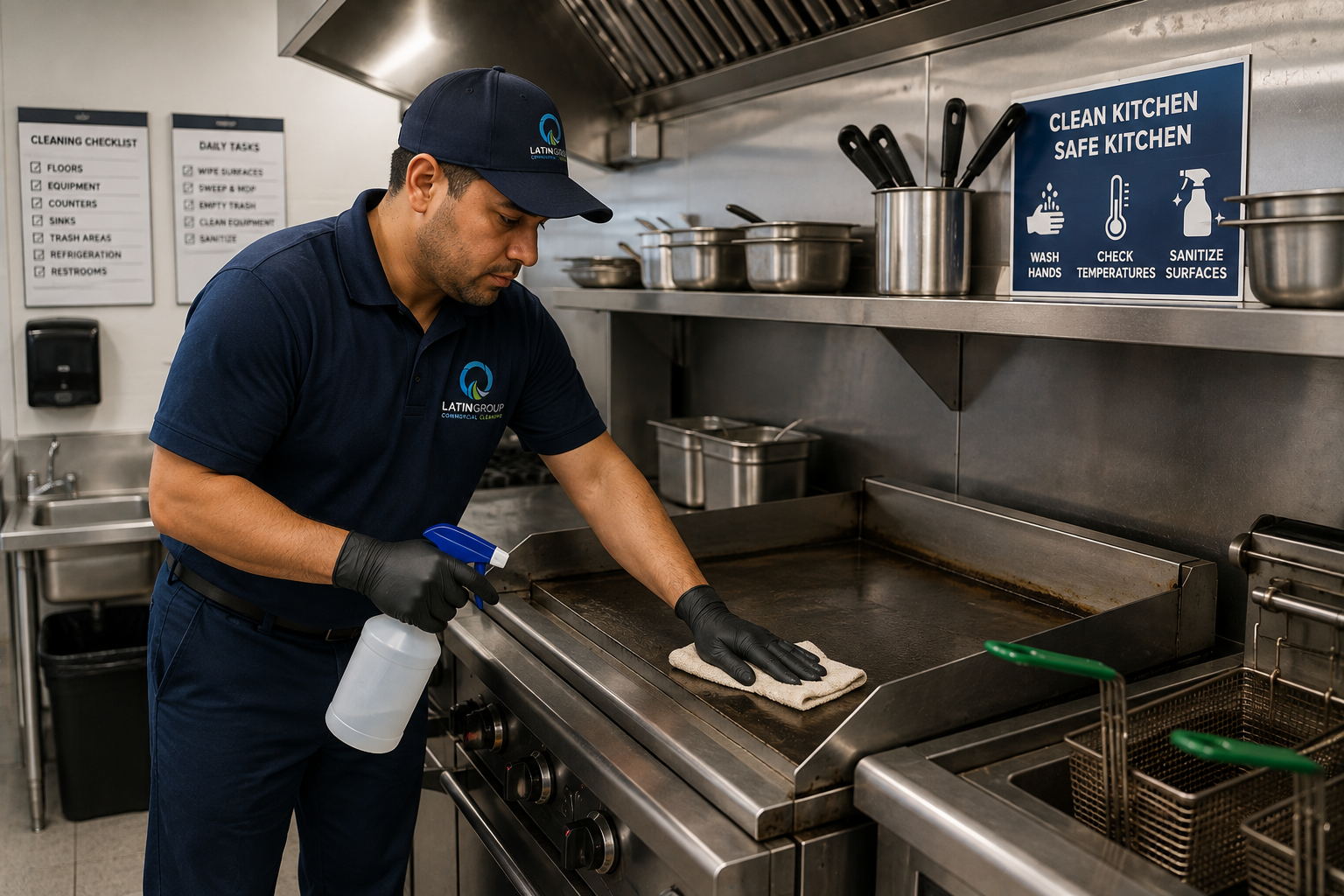
Cleaning Under and Behind Commercial Kitchen Equipment
Visible surfaces are only part of a clean kitchen.
Food debris, grease, dust, and residue can accumulate underneath and behind equipment. Because employees may not access these areas during normal closing procedures, they can become overlooked.
Therefore, periodic deep cleaning should include accessible areas around:
- Cooking equipment
- Refrigeration units
- Preparation tables
- Shelving
- Dishwashing areas
- Storage equipment
Moving commercial equipment can create safety concerns or require specific procedures. As a result, restaurant managers and cleaning providers should determine in advance which equipment cleaners can safely move.
Commercial Hood and Equipment Cleaning
Commercial kitchen exhaust systems require specialized attention.
Grease can accumulate inside hoods, filters, ducts, and exhaust systems. However, restaurants should distinguish general kitchen cleaning from specialized exhaust-system cleaning.
A janitorial or restaurant cleaning company may clean approved exterior surfaces within its scope. Meanwhile, qualified specialists should handle services that require specific expertise, equipment, or fire-safety procedures.
Restaurant managers should clearly define who handles:
- Hood exteriors
- Removable filters
- Exhaust-system components
- Cooking equipment exteriors
- Areas underneath equipment
- Grease buildup around cooking stations
This distinction helps prevent important maintenance tasks from falling between different service providers.
How Floor Cleaning Supports Restaurant Cleanliness
Commercial kitchen floors face constant exposure to food particles, grease, water, and heavy foot traffic.
Routine mopping may not always remove buildup from textured flooring, grout, corners, or heavily used areas. Therefore, periodic machine cleaning or deep scrubbing may become necessary when appropriate for the flooring.
A floor-care plan can include:
- Frequent sweeping
- Appropriate mopping
- Prompt spill cleanup
- Degreasing when necessary
- Detailed edge cleaning
- Periodic machine scrubbing
- Floor drain area cleaning
Moreover, restaurant teams should address slippery or contaminated areas promptly to support a safer working environment.
Common Commercial Kitchen Cleaning Problems
Restaurants can develop cleaning issues gradually, especially in busy kitchens.
Common problem areas include:
- Grease buildup
- Food debris beneath equipment
- Dirty floors or walls
- Residue on surfaces
- Poorly maintained waste areas
- Buildup around cooking stations
- Neglected corners and edges
- Dirty shelving or storage areas
For this reason, managers should inspect more than the areas customers can see.
A clean dining room does not necessarily mean the kitchen is receiving the same level of attention.
Restaurant Failed Inspection Cleaning: What Happens Next?
If a restaurant receives cleaning-related violations, management should review the inspection report carefully and identify every corrective action.
First, determine which violations involve cleaning or sanitation. Next, prioritize issues that require immediate attention. Then, assign responsibility and document the corrective work.
A restaurant failed inspection cleaning response may include:
- Removing heavy grease
- Deep cleaning floors
- Cleaning underneath equipment
- Detailing walls and baseboards
- Addressing storage areas
- Removing accumulated debris
- Cleaning approved equipment surfaces
- Improving the ongoing cleaning schedule
However, restaurants should not treat deep cleaning as a substitute for correcting other food-safety violations. Management must address each issue according to the inspector’s requirements.
Rapid Cleaning After Inspection Violations
When a restaurant needs corrective cleaning quickly, organization matters.
Instead of asking a cleaning company to “deep clean everything,” provide the inspection report or a clear list of affected areas when appropriate.
Then, the cleaning provider can develop a targeted scope based on the facility’s needs.
A rapid-response plan may involve:
- Reviewing cleaning-related concerns
- Identifying priority areas
- Establishing the scope
- Scheduling service
- Completing the approved cleaning work
- Inspecting the areas afterward
- Updating the ongoing maintenance plan
As a result, the restaurant can address immediate cleaning problems while also reducing the likelihood of the same buildup returning.
Choosing a Restaurant Cleaning Company
A professional restaurant cleaning company should understand that commercial kitchens require different cleaning strategies from standard offices.
When comparing providers, ask about:
- Commercial kitchen experience
- Degreasing capabilities
- Floor-care equipment
- Deep-cleaning services
- Scheduling flexibility
- Cleaning products and procedures
- Insurance coverage
- Quality-control processes
- Customized scopes of work
Additionally, an onsite walkthrough allows the provider to evaluate the kitchen before recommending a cleaning plan.
Creating a Preventative Cleaning Schedule
Restaurants should not wait for an inspection problem before evaluating their cleaning program.
Instead, managers can create a preventative schedule that combines employee responsibilities with periodic professional services.
For example, staff can handle daily cleaning while a commercial cleaning provider addresses selected deep-cleaning tasks on a weekly, monthly, quarterly, or customized schedule.
The appropriate frequency depends on:
- Cooking volume
- Operating hours
- Kitchen size
- Type of food preparation
- Grease production
- Floor type
- Equipment layout
- Existing employee cleaning procedures
Ultimately, regular inspections by management can help determine when the schedule needs adjustment.
Professional Restaurant Cleaning in Minnesota
Latin Group Commercial Cleaning LLC provides customized commercial cleaning solutions for restaurants and other food-service facilities in Minnesota.
Depending on the property’s needs, services can include kitchen deep cleaning, floor care, degreasing of appropriate surfaces, restroom cleaning, dining-area cleaning, interior glass cleaning, and other customized commercial cleaning services.
Moreover, we develop the scope around each restaurant’s layout, operating schedule, cleaning priorities, and existing maintenance procedures.
Request a Restaurant Deep Cleaning Quote
If grease, floor buildup, hard-to-reach areas, or cleaning-related inspection concerns require additional attention, a professional walkthrough can help identify the appropriate scope.
Our team can evaluate the facility, discuss priority areas, and develop a customized cleaning plan around your restaurant’s needs.
Contact Latin Group Commercial Cleaning LLC today to schedule a walkthrough and request a customized restaurant cleaning quote.
 Request your FREE quote today and let your business shine.
Frequently Asked Questions About Restaurant Cleaning
Can professional cleaning guarantee that a restaurant will pass a health inspection?
No. Professional cleaning can address cleaning-related conditions, but inspectors also evaluate food handling, temperatures, storage, employee practices, pest control, and other requirements.
How often should a commercial kitchen receive deep cleaning?
The schedule depends on cooking volume, grease production, operating hours, employee cleaning procedures, and facility conditions. Therefore, restaurants should base frequency on actual needs and regular inspections.
What areas are commonly overlooked in restaurant cleaning?
Areas underneath equipment, floor edges, walls near cooking stations, storage areas, equipment exteriors, and other hard-to-reach spaces can accumulate buildup.
Can a restaurant cleaning company clean commercial kitchen hoods?
It depends on the scope. General cleaners may handle approved exterior surfaces, while specialized exhaust-system cleaning should go to qualified providers when required.
Share This Post